


If you’re new here, Eximius is a pre-seed VC fund backing bold ideas across Consumer AI, FinAI, and Enterprise AI.
This week on Eximius Echo, we’re looking at how founders can build a smarter AI cost stack without overpaying for capability they do not need.

The end user sees one answer. Your product may have paid for five things to produce it. A support query can trigger retrieval, classification, reasoning, a tool call, verification and then the final response. An agent may loop through several of those steps before anything even appears on the screen.
That is why AI cost is becoming a product-design decision. For founders, the useful question is no longer “Which model is best?” It is: what level of intelligence is this workload worth paying for?
INTELLIGENCE IS BECOMING A BUDGETING DECISION
Model choice has expanded in two directions at once. Frontier models keep getting more capable, while cheaper and faster models are becoming good enough for a growing set of production tasks.
The gap matters because capability, speed and cost do not move together. Look at how differently that trade-off plays out across some of today’s leading models:
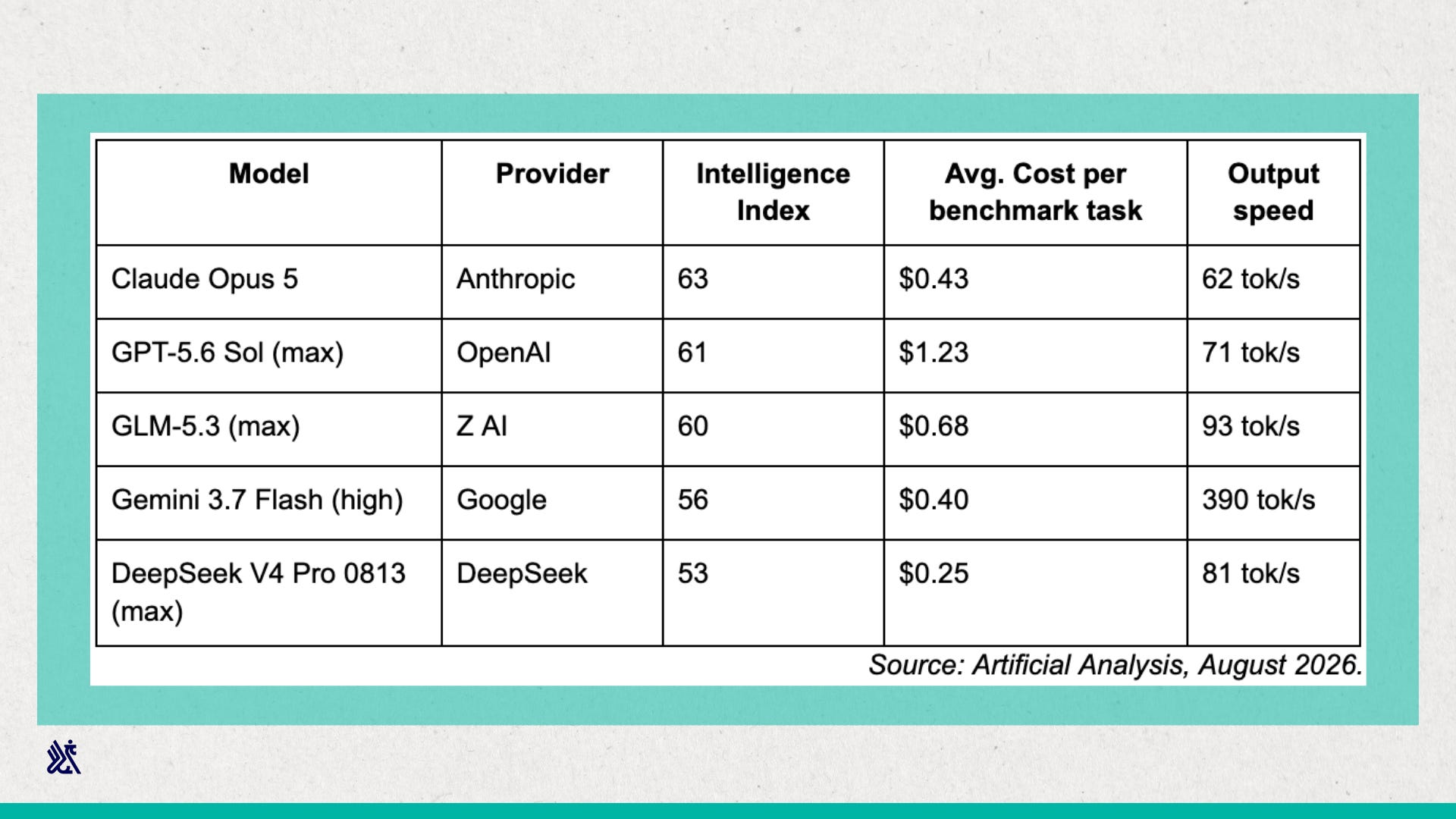
The point is not to pick a winner. The point is that founders can now buy very different combinations of intelligence, speed and cost. Paying for the strongest model everywhere is a choice, not a default.
That creates a new operating discipline: build an intelligence budget.
For an AI-native startup, this budget can sit directly inside gross margin. A model decision that feels trivial at 1,000 requests can become material at 100,000, especially when each request contains several hidden calls.
SO HOW SHOULD FOUNDERS BUILD THAT INTELLIGENCE BUDGET?
A useful intelligence budget comes down to four decisions for every AI workflow:
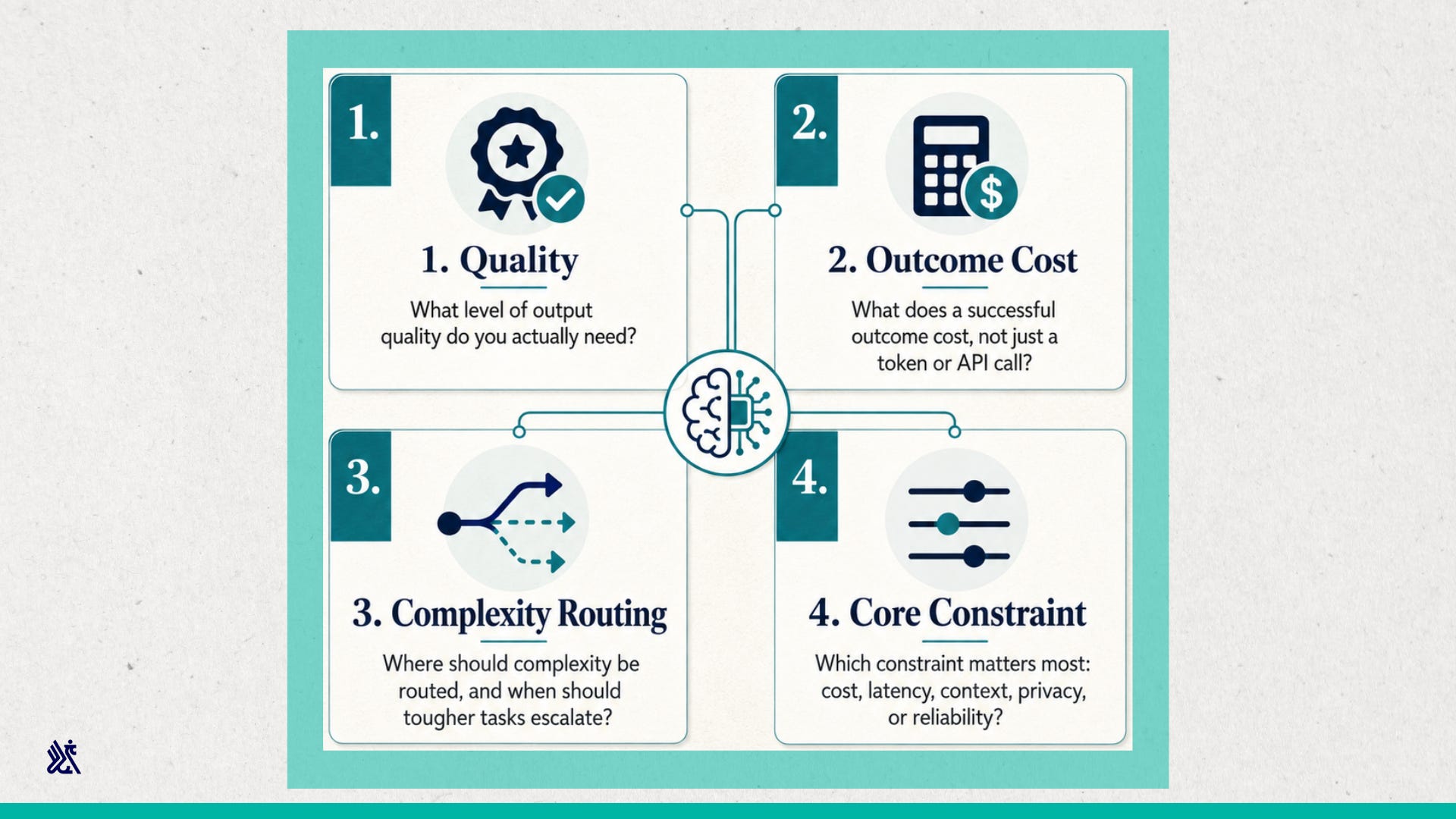
1. Set The Quality Floor
Start with the outcome, not the model.
If you are extracting fields from invoices, classifying support tickets or summarising routine documents, “good enough” may sit well below frontier intelligence.
If you are generating production code, making a financial recommendation or giving an agent permission to act, the cost of being wrong rises sharply.
The model only needs to be as capable as the consequence demands.
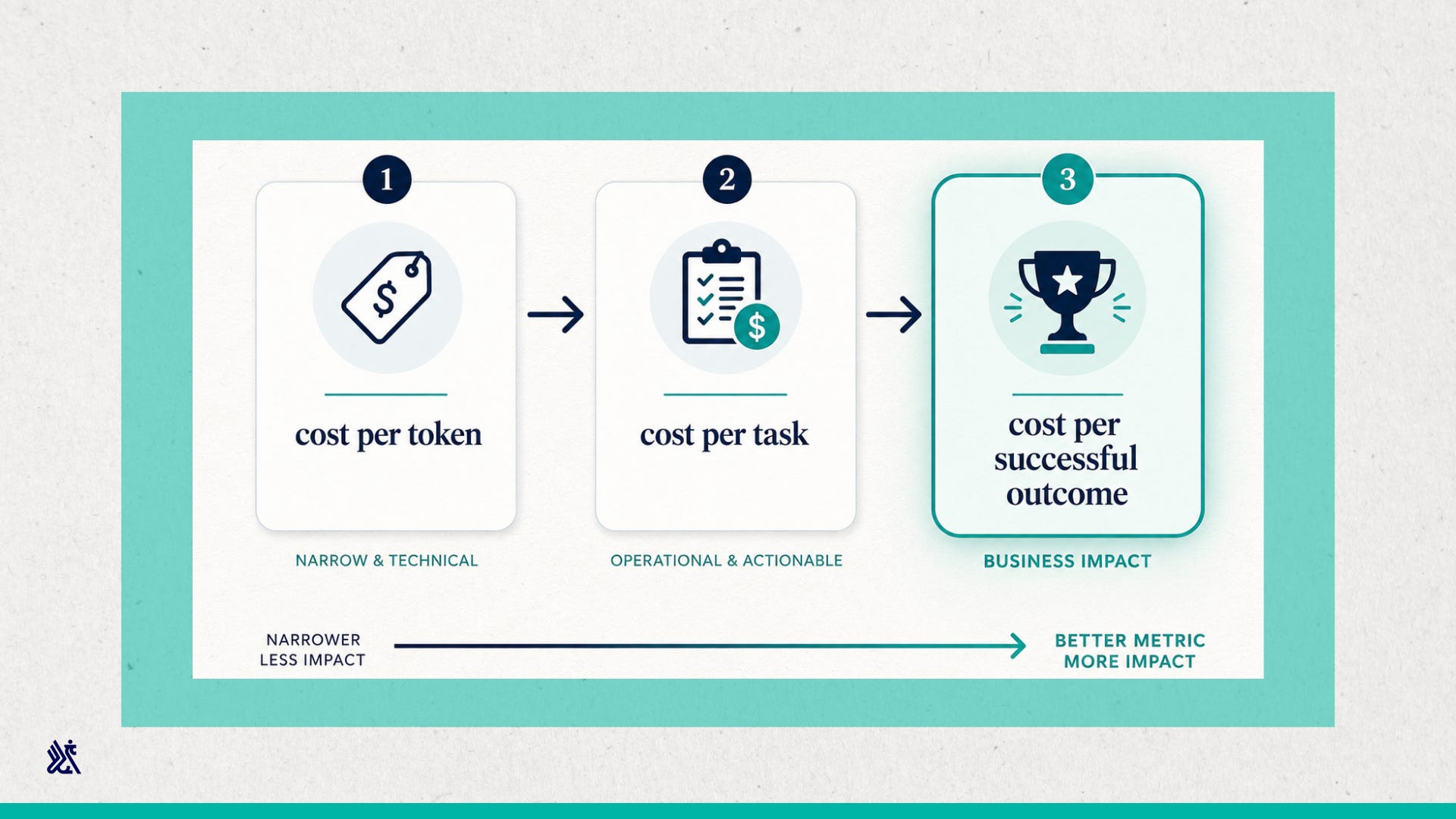
2. Move Beyond Cost Per Token
Model API pricing is easy to compare. It is also easy to over-index on.
Two models can charge very differently per token and still produce very different economics once the task is completed. One may use more reasoning tokens. Another may need retries. A cheaper first attempt can become expensive if it needs repeated correction.
So move the unit of economics forward:
cost per token → cost per task → cost per successful outcome.
That last number is what ultimately hits the business.
3. Route Intelligence, Do Not Standardise It
A startup does not need one model to do everything.
Routine requests can go to a cheaper default. Difficult cases can escalate. Repeated context can be cached, prompts can be trimmed, and reasoning depth can increase only when the workflow demands it.
And not every step needs generative AI in the first place. Deterministic tasks can often be handled more cheaply through traditional ML or rule-based engines, reserving LLMs for the parts of the workflow that need reasoning or generation.
This becomes especially important for agents. One visible user action can translate into planning, retrieval, tool use, retries and verification underneath. Every unnecessary loop adds tokens and cost.
The architecture behind the interface increasingly determines the bill.
4. Know What You Are Optimising For
Cost is one variable in the budget.
A consumer product may trade higher model cost for lower latency. A document-heavy workflow may pay for longer context. A regulated enterprise may accept higher infrastructure cost for privacy or self-hosting. A coding product may spend more on reasoning if it materially reduces failed runs.
The cheapest architecture is not always the most economical one. Know which constraint your product is paying to solve, and whether that premium is worth it.
If you are paying frontier-model prices for work that a cheaper model can reliably handle, or spending tokens your workflow does not need, then yes: you are overpaying for AI.
THE BOTTOM LINE
The model race is creating abundance. For founders, that creates an allocation problem.
The advantage will come from knowing where premium intelligence materially improves the outcome, where cheaper intelligence clears the bar, and how to move between the two as the product scales.
The winning AI product may not use the smartest model everywhere. It will know exactly where intelligence is worth paying for.
If you’re building the next generation of AI products, we’d love to hear from you. Write to us at pitches@eximiusvc.com.
Cost per successful outcome is the number. Cheap tokens look great right up until retries, review, and cleanup eat the savings. I’d track human minutes per completed task too, because that’s where the fake bargains usually show up.