
The Inference Bottleneck: Three Answers to AI’s Next Infra Challenge
The real test begins once GPUs start serving real workloads.


If you’re new here, Eximius is a pre-seed VC fund backing bold ideas across Consumer AI, FinAI, and Enterprise AI.
This week on Eximius Echo, we’re looking at how the AI infrastructure stack is being reworked to get more performance from every GPU.

For the last few years, AI infrastructure has been built around training: larger models, bigger clusters, more GPUs. This defined the first wave of the AI buildout.
The next wave is being shaped by inference: running models continuously across products, workflows, enterprises, and software systems. This year, inference is expected to account for roughly two-thirds of AI compute, up from one-third in 2023 and half in 2025.
Agents are accelerating this shift. A chatbot answers a prompt. An agent plans, retrieves context, calls tools, switches between models, checks outputs, and repeats until the task is complete. Each step adds inference demand. Each workflow adds latency pressure.
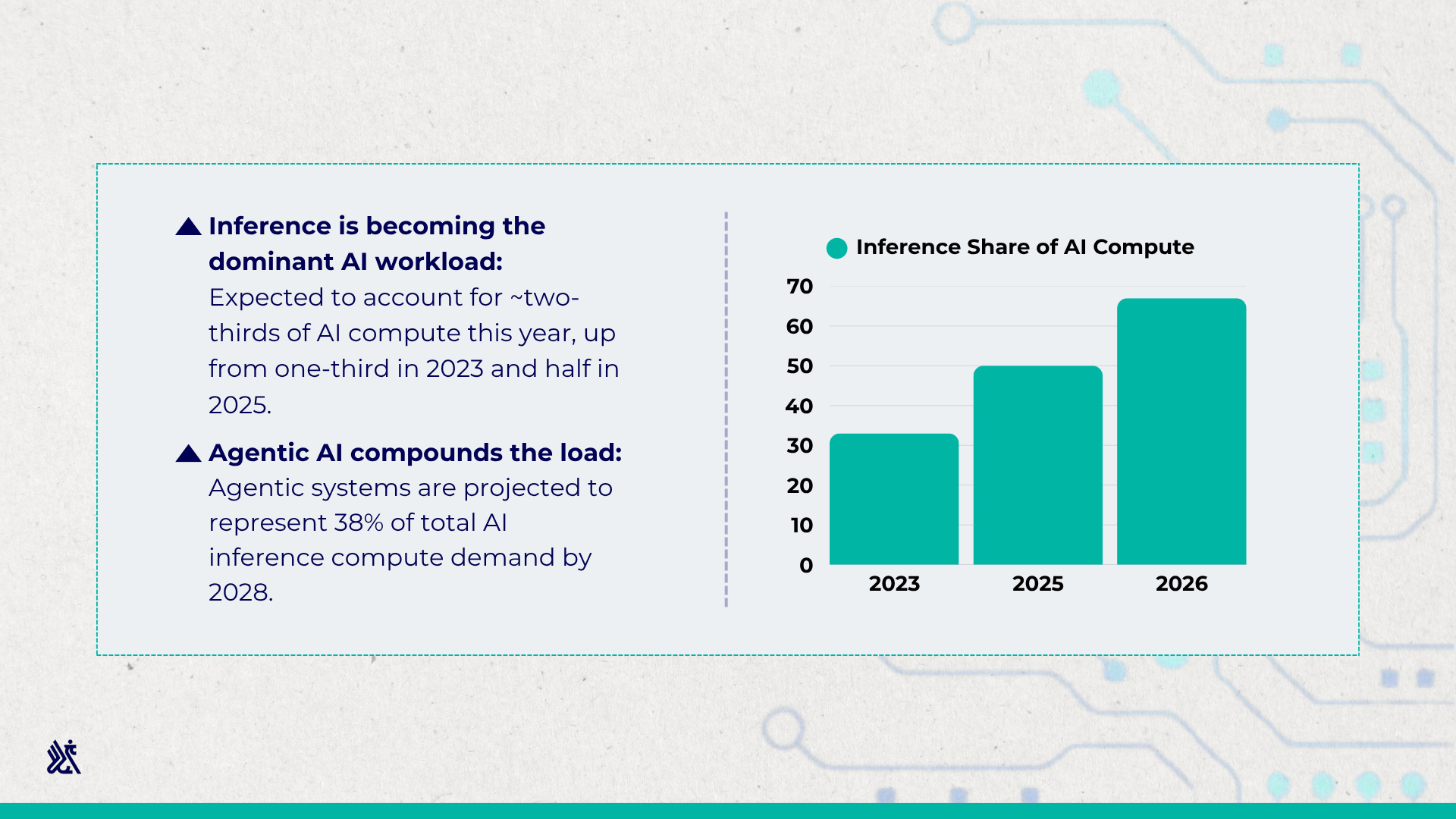
Efficiency gains are not reducing demand either. Quantisation, distillation, and mixture-of-experts architectures can cut compute cost per inference token by 40% to 80%. However, lower costs make more use cases viable, expanding the total surface area for AI.
This creates the infrastructure paradox of the agentic era: GPUs are more powerful than ever, yet supply constraints, data movement, and scheduling inefficiencies still leave significant capacity underused.
So the question for 2026 is clear: how do we extract more performance from the GPUs we already have?
Three answers are emerging, each focused on a different layer of the stack.
Approach #1: RETHINK THE HARDWARE ITSELF
Today’s GPUs were built for more predictable AI workloads: train a model, run batches of inference, move data through the system. Agentic AI behaves differently. It keeps context alive, moves between models, runs longer sessions, and demands lower latency at every step.
That creates a hardware problem. Each time a system reloads model weights or moves data between memory and compute, performance leaks, latency rises, and energy gets wasted.
This approach asks a sharper question: what would inference hardware look like if it were designed specifically for agentic workloads?
The answer is purpose-built silicon where multiple models can stay resident on-chip, session memory can persist separately from compute, and compliance checks can happen closer to the hardware layer. The aim is to reduce the cost of switching between models and make long-running, multi-model AI systems faster and more energy efficient.
Company to watch: Phynomy, which is building inference chips for agentic AI with multi-model residency and hardware-level compliance validation.
Approach #2: FIX THE DATA PIPELINE
The argument here is simple: the chip may be fast enough, but the system feeding it is not.
Modern inference workloads depend on datasets, vector stores, file systems, retrieval layers, and memory hierarchies. When data arrives late, GPUs wait, and that’s expensive.
As inference becomes more data-intensive, utilisation becomes a data movement problem. The bottleneck is no longer only how fast the GPU can compute, but how reliably the right data reaches it at the right time.
The focus is the path between storage and compute. Intelligent caching, AI-native storage, and workflow-aware orchestration keep data staged before the GPU needs it. The goal is to reduce idle time and get more output from the same infrastructure without changing the chip.
Company to watch: TensorMem, which is building an AI-native data acceleration layer aimed at closing the “AI Memory Wall.”
Approach #3: OPTIMISE HOW WORK GETS SCHEDULED
Modern AI applications rarely run one model at a time. A single agentic workflow may call a speech model, an LLM, an embedding model, a reranker, a vision model, and a retrieval system in sequence.
Today, these models are often deployed as separate services. Each service may hold dedicated GPU capacity that sits idle between tasks. The result is fragmented infrastructure, even when total demand is high.
This camp treats inference like an operating system problem. Instead of reserving fixed GPU capacity for individual models, compute is allocated dynamically across workloads in real time. GPUs become a shared pool that can move with demand.
The goal is to raise utilisation, reduce inference costs, and make multi-model workflows easier to run at scale.
Company to watch: Neurafewz, which is building an inference OS with a compiler and runtime scheduler that shares GPU resources across multi-model workflows.

Why These Layers Reinforce Each Other
These approaches operate at different layers of the stack.
A future deployment could look like this: an inference OS schedules multi-model workloads, a data acceleration layer keeps inputs ready before the GPU needs them, and next-generation silicon executes the workload with lower latency and less energy waste.
Each layer compounds the value of the others. Scheduling improves utilisation. Data acceleration removes upstream stalls. Purpose-built hardware reduces the cost of execution.
The companies building at each layer may sell to different budgets today, but the strongest AI infrastructure stacks will bring these pieces together. As inference becomes the dominant AI workload, the winners will be the teams rebuilding every layer that determines how much value each GPU can deliver.
If you’re building at the intersection of AI infrastructure, inference optimisation, compute efficiency, or agentic systems, write to us at pitches@eximiusvc.com. We’d love to hear what you’re building.
 |
|